
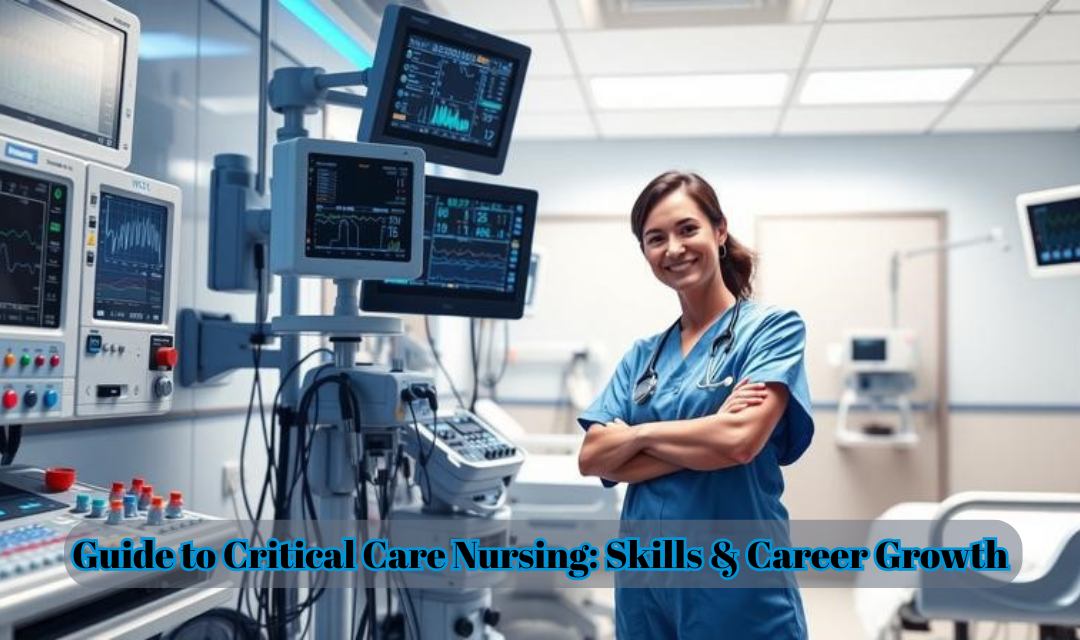
Critical care nursing remains one of the most highly specialized and influential roles in modern healthcare. With the expanding demand for ICU services across U.S. hospitals—driven by aging populations, chronic illness, trauma, and surgical complexity—the need for educated, confident, and well-prepared critical care nurses has never been greater.
Whether you’re transitioning from general nursing, starting a critical care nurse residency, or simply exploring career direction, this guide breaks down the essential skills and responsibilities required to excel in the ICU—and where the profession is headed.
What Is Critical Care Nursing?
Critical care nursing focuses on delivering comprehensive, continuous care to patients with life-threatening conditions. These patients may be recovering from major surgery, suffering trauma, organ failure, complex infections, cardiorespiratory instability, neurological compromise, or multi-system failure.
The role of the critical care unit in modern healthcare
The ICU’s value extends far beyond a physical hospital unit. It plays a central role in:
- Reducing inpatient mortality rates
- Preventing complications through close monitoring
- Enabling rapid medical and surgical intervention
- Managing complex medications and life-support technology
- Supporting multidisciplinary decision making
U.S. hospital systems continue to expand ICU resources, and the demand for qualified critical care unit nursing staff reflects that strategic priority.
Differences between critical care nursing and general nursing
Compared to traditional bedside nursing, critical care nursing requires:
- Higher levels of clinical autonomy
- Greater involvement in physician collaboration
- Complex medication and infusion management
- Rapid assessment and response
- Frequent use of advanced equipment and monitoring
While both roles share core nursing fundamentals, ICU practice demands a higher level of critical thinking and real-time clinical judgment.
Core Responsibilities of a Critical Care Nurse
The scope of responsibilities for nursing in critical care is wide-ranging—and expected to evolve as healthcare modernizes.
Monitoring unstable patients
Critical care nurses must observe and respond to rapid changes in:
- Respiratory distress
- Hemodynamic instability
- Neurological function
- Pain, sedation, and delirium
- Organ support equipment
Patients’ needs may change minute-to-minute, reinforcing the need for vigilance and advanced clinical reasoning.
Managing complex medical equipment
From ventilators to ECMO, ICU nurses operate and troubleshoot life-sustaining technology. You may interact with:
- Central line and arterial line monitoring
- Mechanical ventilation
- Continuous renal replacement therapy
- Medication pumps and infusions
- Specialized diagnostics and monitoring
These tools allow nurses to detect complications early, stabilize patients, and collaborate effectively with physicians and critical care teams.
Emergency response and rapid clinical decision making
ICU nurses are often first responders for:
- Code blue events
- Cardiac arrest
- Respiratory failure
- Sepsis and shock
- Sudden declines in vitals
The ability to assess, prioritize, and intervene is a defining skill for ICU professionals.
Critical Care Nursing Education and Certification
What a critical care nurse residency program teaches
A critical care nurse residency is the gold-standard for preparing new ICU professionals. Programs typically include:
- Clinical rotations and mentorship
- Simulation-based training
- Advanced pharmacology and assessment
- Emergency response protocols
- Communication and leadership development
Many U.S. hospitals now require or strongly encourage residency participation because it accelerates new-ICU-nurse confidence and reduces training time.
Certifications and continued professional development
Professional credentials strengthen credibility and update clinical knowledge. Popular certifications include:
- CCRN (Critical Care Registered Nurse)
- CMC and CSC for cardiac specialties
- ACNP and AG-ACNP for advanced practice
- Trauma and emergency response courses
Continuing education enables ICU nurses to stay aligned with evolving healthcare technology, patient safety protocols, and national practice standards.
Must-Read Critical Care Nursing Books
Reading and continued training help ICU nurses stay adaptable and forward-thinking. A great critical care nursing book does more than provide theory. It offers:
- Real-world case studies
- ICU patient scenarios
- Stress and time-management strategies
- Step-by-step guidance for skill development
- Communication models for team-based care
Critical care nursing requires lifelong learning, and literature plays a substantial role in professional growth.
Why every new ICU nurse should invest in continuous learning
The complexity of ICU care means that formal education alone isn’t enough. Reading strengthens:
- Decision making
- Advanced assessment and clinical judgment
- Interdisciplinary collaboration
- Safety and error avoidance
- Technology competence
Books bridge the gap between training and real-world experience.
Daily Routine & Challenges of Nursing in Critical Care
High-pressure situations
ICU nursing is fast-paced and emotionally demanding. The stakes are high, and environments often involve:
- Rapid vital sign changes
- Ethical decision making
- Competing priorities
- Family communication around critical illness
The profession requires a calm, solution-focused mindset—not panic or hesitation.
Stress management and mental resilience
Burnout prevention is a core career strategy. Successful ICU nurses develop:
- Work-life balance
- Self-reflection and debriefing habits
- Support networks and mentorship
- Emotional intelligence
- Mindfulness and coping strategies
The most successful ICU professionals combine clinical excellence with personal resilience.
The Future of Critical Care Nursing
Technology and changing patient demographics
Critical care nursing is entering a transformative era. Hospitals are investing in:
- Artificial intelligence and predictive analytics
- Tele-ICU programs
- Advanced monitoring systems
- Expanded specialty ICUs
- Robotics and automation
Meanwhile, U.S. patient populations are aging—requiring more advanced, personalized critical care.
These shifts will open new career paths in:
- Telemedicine
- Nurse leadership
- ICU specialization
- Healthcare technology
- Critical care research
The field is expanding—and with it, opportunities to lead.
Recommended Resource – Pathway to ICU by Karen Ann Thompson
A guide for nurses stepping into the critical care unit
Pathway to ICU is an indispensable handbook for nurses transitioning into intensive care or starting their first ICU shifts. It provides:
- The core skills and competencies of an ICU nurse
- Real-world patient scenarios
- Critical thinking strategies
- Communication tools for patients and families
- Practical ways to build confidence and reduce stress
The book stands out because of its author’s real-world experience.
About the Author — Karen Ann Thompson, M.S., RN
Karen Ann Thompson brings more than 40 years of nursing expertise to her writing. She holds advanced credentials in nursing administration and works on the surgical team of a Houston medical center. Her firsthand experience makes Pathway to ICU both authentic and highly practical.
Final Thoughts
Keys to success as a new or aspiring critical care nurse
If you’re entering critical care nursing or planning to advance professionally, here’s where to focus:
- Strengthen your foundation through ongoing education
- Build clinical confidence through mentorship and residency programs
- Develop emotional resilience and stress-management skills
- Commit to lifelong learning and professional certifications
- Invest in books and training resources that accelerate your growth
Critical care nursing isn’t just a job—it’s a transformational career that impacts lives, families, and the future of U.S. healthcare. For nurses transitioning from floor nursing or seeking support as a new ICU clinician, resources like Pathway to ICU provide exactly the guidance needed to excel in this rapidly evolving field.
